Seed to Sunflower
Pardeep Singh
| 25-04-2026
 · Plant Team
A single sunflower seed looks simple—small, striped, easy to overlook. Yet inside that shell lies a complete blueprint for growth, timing, and transformation.
Given the right conditions, one seed can become a towering plant, and many seeds together can turn an open field into a vibrant sea of yellow.
What's Inside a Sunflower Seed?
A sunflower seed is more than just a food source—it's a compact survival system. Beneath the outer shell is the kernel, which contains the embryo and stored nutrients.
This internal structure includes:
• A protective outer coating to prevent damage
• Stored energy to support early growth
• A tiny embryonic plant ready to develop
The seed remains dormant until environmental conditions—mainly moisture and temperature—signal that it's time to grow.
The Germination Process
Once planted in soil and exposed to water, the seed begins to absorb moisture. This triggers a series of biochemical changes that activate growth.
1. Water absorption
The seed swells as it takes in moisture, softening the outer shell.
2. Root emergence
The first structure to appear is the root, anchoring the plant and absorbing nutrients.
3. Shoot development
A small shoot pushes upward, breaking through the soil surface.
4. Leaf expansion
Initial leaves open, allowing photosynthesis to begin.
This stage is delicate, as the young plant depends heavily on stored nutrients before it can produce its own energy.

Rapid Growth and Structure
Sunflowers are known for their fast growth rate. Within a relatively short period, the plant develops a thick stem, broad leaves, and eventually a large flower head.
Key growth features include:
• Strong vertical stems that support height
• Wide leaves that maximize sunlight capture
• A central bud that gradually expands into a full bloom
As the plant grows taller, it competes more effectively for sunlight, which is essential for continued development.
The Mathematics of the Flower Head
One of the most fascinating aspects of sunflowers is the arrangement of seeds within the flower head. The seeds form spiral patterns that follow mathematical principles often associated with efficient packing.
This pattern allows:
• Maximum number of seeds in limited space
• Even distribution for structural balance
• Efficient use of resources during development
The result is a visually striking design that also serves a functional purpose.
From Flower to Hundreds of Seeds
A mature sunflower doesn't produce just one seed—it can generate hundreds or even thousands. Each tiny floret in the center of the flower has the potential to become a seed.
This transformation involves:
• Pollination, often assisted by insects
• Gradual development of individual seeds
• Drying and hardening of the outer shell
Once mature, the flower head begins to tilt downward slightly, protecting the seeds and preparing them for dispersal.
Seed Dispersal and New Growth
After maturation, seeds are released or collected, depending on the environment. In natural settings, wind, animals, and gravity all play a role in spreading seeds.
1. Natural drop
Seeds fall near the parent plant, starting a new growth cycle.
2. Animal interaction
Some seeds are carried away and stored elsewhere.
3. Environmental spread
Wind and movement help distribute seeds over wider areas.
Each dispersed seed carries the potential to begin the process again.
Conditions That Shape Success
Not every seed becomes a full-grown sunflower. Success depends on several environmental factors:
• Adequate sunlight exposure
• Well-drained soil
• Consistent moisture during early stages
• Enough space to grow without competition
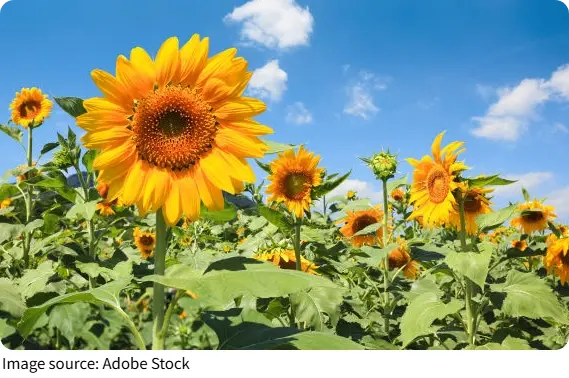
When these conditions align, the result can be dramatic—fields filled with synchronized blooms, all originating from individual seeds.
From a single seed to an entire landscape of flowers, sunflowers demonstrate how small beginnings can lead to expansive results. Their growth is not just a process, but a sequence of precise steps shaped by nature's efficiency. What starts as a quiet, unnoticed seed can ultimately transform into something bold, structured, and impossible to ignore.